

Data quality within everyone's reach

Poor data costs you around 10% of your revenue. We show you where.

Data doesn't need to be perfect. It needs to be adequate: reliable enough for your purpose and process. The MAD-Validator shows you within one day where your data falls short and what that costs you per year. In time and in euros.

  • First results within 1 day
  • Data stays in your own environment
Two employees walk through a warehouse discussing a list The front line feels it first
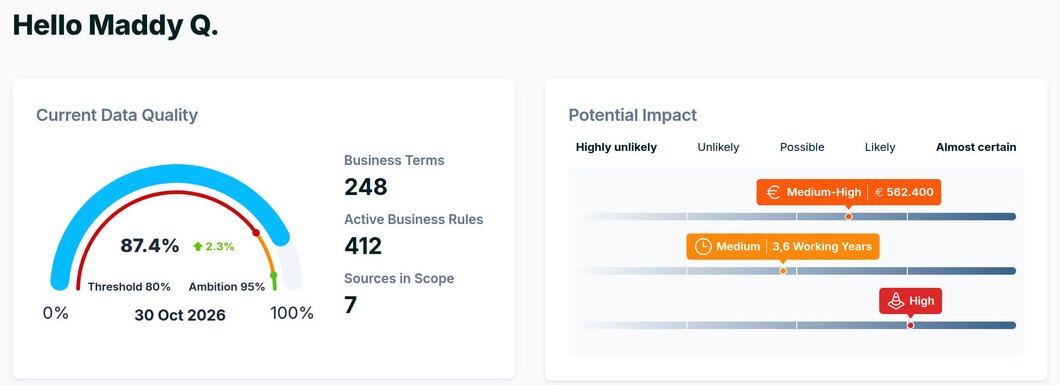
MAD-Validator dashboard: data quality 87.4 percent, threshold 80 and ambition 95 percent. Potential impact: financial medium-high (€562,400), time medium (3.6 working years), risk high.
The MAD-Validator, sample data
±10%

of annual revenue was lost to inadequate data. Measured and substantiated at several organisations with €200M to €400M in revenue.

1 day

to get the first concrete findings, after a well-prepared start.

0

records leave your environment unnecessarily or without your explicit instruction. We have no direct access to your data.

3 months

of Proof of Value to prove it. No demonstrable value, no follow-up.

Film · 36 seconds

Why your data needs to be adequate

In half a minute you see how we tackle it. Every rule gets a price tag, in euros, time or risk. You see straight away where most attention should go, and what you gain by starting there.

Worked example

What does inadequate data cost you?

Inadequate data costs organisations 7 to 15% of their revenue. Slide to your annual revenue and see what that means for you.

The evidence
Impact on revenue7% to 15%
  • GartnerResearch into the cost of poor data quality arrives at 7 to 15% of revenue.
  • Our methodMAD-Quality calculates with 10%. That figure comes from our methodical approach, measured and substantiated at several organisations.
Why don't you see this in the numbers?

Because it's hidden pain. People work around it every day, with extra checks, corrections and their own Excel lists. Those hours and errors are never booked as data quality. So everything seems to add up while the money leaks away.

Where it sits for you depends on your processes, systems and sector. You get that figure from the baseline measurement, substantiated rule by rule.

€50M€500M€1.5bn
Estimated cost of inadequate data
€10.5M to €22.5Mper year
€47,727 to €102,273per working day
€5,966 to €12,784per working hour

A Proof of Value costs €3,000. That's what poor data costs you in 14 to 30 minutes.

View the Proof of Value
Recognise this?

It nearly always starts like this

Data quality becomes a topic as soon as someone with a mandate runs into it personally and wants to make it tangible for the whole organisation. It usually happens at one of these moments.

  1. 01Our AI or BI project is stuck on the dataModels and dashboards are only as good as the data underneath.AI
  2. 02Finance and operations report different numbersAnd every meeting starts with the question of which number is right.Leadership
  3. 03We have to demonstrate NIS2, CSRD or ISO complianceDemonstrating starts with knowing what's in your systems.Compliance
  4. 04The auditor has a findingA finding is a warning sign. Usually not the only one.Audit
  5. 05We're migrating to a new ERP or WMSMigrate poor data and the problems come with you.Migration
  6. 06Our Product Master Data is structurally wrongWrong dimensions, weights and locations. Rework every day.Operations
  7. 07Customers receive the wrong invoices or deliveriesWhat's an annoyance on the inside becomes reputational damage on the outside.Customer
  8. 08A new CFO wants to know what's really in the systemsA fresh pair of eyes asking for hard facts.Leadership
Our conviction

Adequate is good enough. And good enough is exactly right.

Inadequate

Costs money, time and trust. According to Gartner research, 7 to 15% of revenue disappears here. MAD-Quality calculates with 10%.

Adequate

Reliable enough for your purpose and process. This is where your data delivers the most.

Perfect

Sounds good and costs more than it delivers. This is where many data programmes get stuck.

Most data quality programmes aim for perfection and run aground in a multi-year plan. We start by asking what's good enough for your processes, and we measure against that. That makes it manageable, measurable and affordable. It also makes ownership possible, because everyone understands where the bar is.

To make the digital world a little better, you have to be a little mad. That's us: MAD. Maximize Adequate Data.

Go-MAD! · the approach

From first measurement to proven results

No months of preparation. You see what's going on from day one, and what it delivers after three months.

  1. Day
    1

    The foundation is in place, the first validations are running

    In the first few hours we lay the foundation and connect to your source systems. Then we get to work on the first validations, in your language and for your processes. By the end of day 1 the first validations are live.

    With the right preparation you see the first findings the same day.

  2. Week
    2

    Everything in understandable impact

    We translate every finding into impact that everyone understands: in concrete euros and time where possible, and always in severity. So you see what takes priority and what can safely wait.

  3. Months
    1 to 3

    Managing by what it delivers

    Every finding is assigned to a named user. Owners see at a glance where the priority should be. So every problem ends up with the person who can solve it. At the end you have your MAD-Effect, expressed in Return on Improvement: what tackling data quality delivers for your organisation.

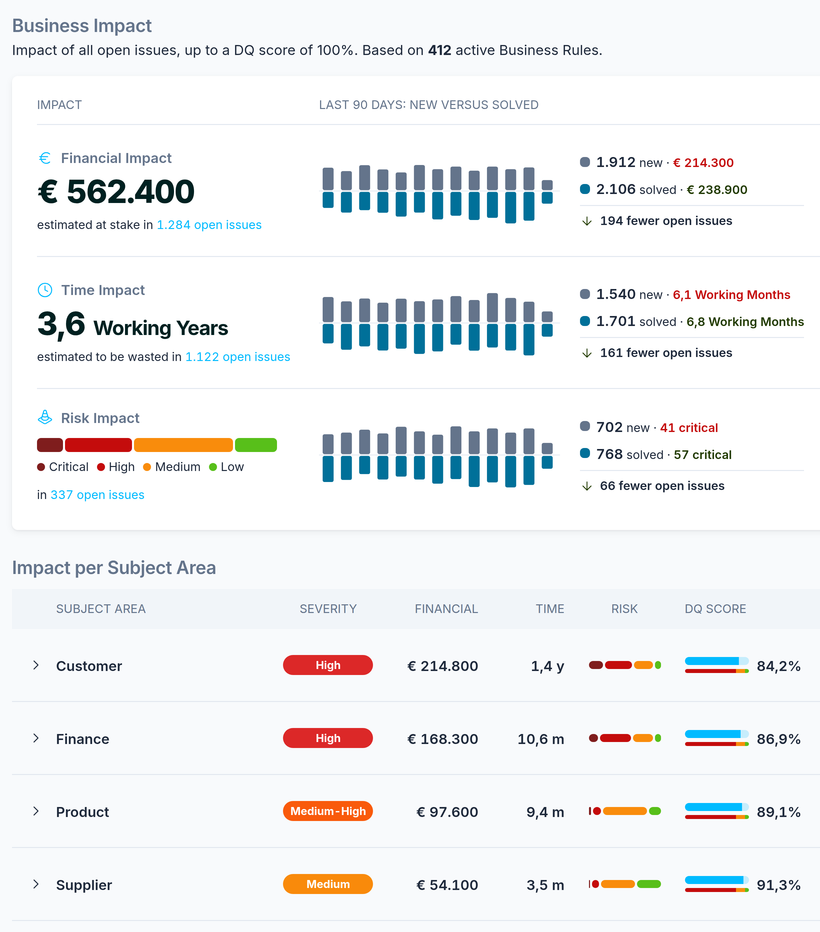
Business Impact in the MAD-Validator: financial impact €562,400, time impact 3.6 working years and risk impact across 337 open issues, with severity, impact and DQ score per subject area.
Business Impact in the MAD-Validator, sample data
The solution

MAD-Validator

The data quality solution that tests your data against your own rules and translates every finding into understandable impact.

The programme

Go-MAD!

From first measurement to lasting improvement, with confidence across the whole organisation.

The result

MAD-Effect

One number: your Return on Improvement. What tackling data quality delivers for you.

Cases

What we found, in euros

The method behind the MAD-Validator has been applied and substantiated at organisations in various sectors. The outcome was larger than expected every time, both on the front line and in the boardroom.

Colleagues meeting at a conference table with laptopsAnonymised
€200M revenue
≈ €20Mper year due to inadequate data, on a conservative estimate. That's around 10% of revenue.
  • Data processed or stored incorrectly: a sizeable impact on money, time and risk
  • Data for one specific process was 15% out of order, which led among other things to unexpected services being delivered
  • Around 85% of the data was good, against the organisation's own standard of 94%
"Data is processed with good intentions, with regular labour-intensive rework as a result."Conclusion from the baseline measurement
Large distribution centre with racking and yellow cratesAnonymised
Logistics · €400M revenue
€30M to €40Mper year due to inadequate data, on a conservative estimate. That's 7.5% to 10% of revenue.
  • Invoices and payment reminders failed to arrive because of invalid email addresses
  • Weights were checked and corrected by hand, in two departments
  • Around 80% of the data was good, against the organisation's own standard of 99%
"Poor data was created to get around other poor data."Conclusion from the baseline measurement

Organisations remain anonymous at their own request. Figures are rounded.

Leadership meeting at a long table with laptops
Who it's for

Data quality belongs in the boardroom

The MAD-Validator suits organisations where leadership stays close to operations, recognises the problem and is up for the adventure.

Feels the painThe front line, working around it every day
Sees the painFinance, BI and data teams, trying to straighten it out in pipelines and Excel
DecidesLeadership, because it affects the whole organisation
€50M+ revenue100+ FTEData-intensive
ManufacturingLogisticsHealthcarePublic sectorBusiness services
An honest comparison

Can't our BI team build this themselves?

Technically, often yes. The question is what it costs, how long it takes and who maintains it afterwards.

With the MAD-ValidatorBuild it yourself
First resultDay 1Usually after months of building and testing
Impact per findingStandard, in euros and time where possible, always in severityBuild and maintain a separate model
Changing rulesBy the business itself, with minimal codeThrough a ticket on the BI backlog
OwnershipBuilt inTo be organised separately
Insight and actionsIntegrated, in one environmentOften separate lists of findings
MethodGo-MAD!, proven in several sectorsWork it out yourself
Cost of first 3 months€3,000 for the Proof of Value, plus your partner's time. No Cure No Stay.FTE hours, and tools bought for other purposes

The best result? Thanks to the MAD-Validator, your BI team does what it enjoys: giving insight into the business, instead of keeping lists of errors.

The offer

Proof of Value: three months to prove it

You don't have to take our word for it. Nor do you have to wait until we're working with all your competitors. We take the risk. A certified implementation partner carries out the Proof of Value with you. MAD-Quality supplies the MAD-Validator and the Go-MAD! method.

€3,0003 months
excl. VAT
  • First Business Rules drawn up together
  • Every finding translated into impact, in euros and time where possible
  • Priority list, every finding assigned to a named person
  • Your MAD-Effect live in a dashboard for leadership, in plain language. Technology is the means.
  • Guidance from a certified partner. Ruud is always close by.

What the partner does. The partner helps you adopt and set up the MAD-Validator, draws up the first Business Rules with you and guides your team. The €3,000 covers the MAD-Validator and the method. Depending on the partner, costs for guidance come on top. Not sure which partner suits you? Book half an hour and we'll look together at the best match for your sector.

No Cure
No Stayguarantee

No demonstrable value, or is your house already in order? Then we stop.

If the Proof of Value shows no demonstrable value after three months, or your data turns out to be adequate already, you don't have to continue. No follow-up contract, no notice period, no surprises.

Do you see the value? Then you continue with Pay for Value. You pay according to where the value comes from: the validations actively working for you. Users and servers don't count. If it delivers more, you pay more. Monthly, in arrears.
Secure and scalable

Your data stays where it belongs

Stays with you

Records never leave your environment unnecessarily or without your explicit instruction. We have no direct access to your data. By default you see only the validation results.

Scalable

Connecting all your sources is the goal. The architecture is designed to add new sources quickly, together with our implementation partners.

Managed in the Netherlands

Hosting and management by TrueFullStaq. Data processing agreement included as standard.

Live quickly

No big IT project. With a prepared environment, the first measurement runs within a day.

About us

Who picks up the phone

MAD-Quality is big on experience and small in organisation. That's an advantage: you talk to the people who came up with the method and built the solution.

Portrait of Ruud Kuil
Co-founder & CPTO

Ruud Kuil

"Perfect data doesn't exist. Adequate data does, and you can measure it."

Data quality expert and the mind behind the MAD-Validator. Developed the method with which he showed, at several organisations, that inadequate data costs around 10% of revenue.

Follow Ruud on LinkedIn
Portrait of Marcel Ensing
Co-founder

Marcel Ensing

"I help leadership teams measure what poor data costs them."

CIO in healthcare with years of experience at boardroom level. Brings structure, calm and focus, and knows better than most what a data issue looks like from the top.

Follow Marcel on LinkedIn
Questions

What we get asked most

Is your question not here? Just ask. Asking a question is the first step to the answer, and Ruud has that answer.

What do you mean by adequate data?

Data that's reliable enough for the purpose you use it for. An address on an invoice asks for something different from an address for a delivery route. Together we decide per process where the bar is, and the MAD-Validator measures against that.

How quickly will we see results?

After a well-prepared start, you see the first findings on day one. Within a week the MAD-Validator is fully running and the main findings are lined up with their impact.

What exactly does No Cure No Stay mean?

The Proof of Value lasts three months. The MAD-Validator and the method cost €3,000, and the partner's guidance comes on top. If the Proof of Value shows no demonstrable value, or your data turns out to be adequate already, you stop. There's no follow-up contract and no notice period.

Who carries out the Proof of Value?

A certified implementation partner. MAD-Quality supplies the MAD-Validator and the method. The partner helps you adopt and set up the MAD-Validator, draws up the first Business Rules with you and guides your team.

Does our data leave our own network?

Not unnecessarily, and never without your explicit instruction. We have no direct access to your data. By default, only the validation results appear in the dashboard. We shield incoming data from users who don't need to work with it directly. And all data has a retention period: what's no longer needed, we don't keep.

Which systems does it work with?

Currently MS SQL and PostgreSQL. Most systems, such as ERP, CRM and electronic care and patient records, run on one of those two. We can easily add a new connection if you ask for it. You have to start somewhere.

What does it cost after the Proof of Value?

You pay monthly in arrears, according to where the value comes from: the validations actively working for you. Users and servers don't count. We call that Pay for Value. We discuss what it means for you during the Proof of Value.

How do you arrive at that 10%?

The method at the basis of the MAD-Validator was used to calculate, with substantiation, what inadequate data costs at several organisations in various sectors, with €200M to €400M in revenue. The outcome was around 10% of annual revenue. Your own figure comes from the baseline measurement.

Take the first step

Book half an hour with Ruud

You tell us where it hurts. Ruud tells you honestly whether, and where, the MAD-Validator will deliver something. Half an hour, online.

Introduction with Ruud30 minutes · online

Choose a time in Ruud's calendar yourself. You'll receive the invitation by email.

The calendar runs on HubSpot and only loads after you click (see the privacy statement). Open the calendar in a new window

Call RuudBook half an hour