
Why data leadership isn’t about dashboards, it’s about trust
Every organization wants to be data-driven. Investments are made in dashboards, reports and KPIs, because measuring is knowing, right?
But frankly, data-driven work doesn’t exist.
You work human-driven or process-driven and data is a consequence of that.
Yet “data-driven working” remains a popular phrase. It sounds modern, smart, controllable. But true grip on data is not about numbers; it’s about confidence.
Or more precisely, about dataconfidence.
Because if the data behind all those numbers itself cannot be trusted, then knowing is mostly thinking you know.
The silent chaos behind the numbers
Beneath every beautiful dashboard often lies a messy reality. Sources contradict each other, figures vary by department, and no one knows which version is correct.
It may seem familiar to you: “Power BI says something different than the source system.”
That’s not only frustrating, it’s a symptom of something bigger: data chaos.
We store everything “just in case,” while research shows that more than 90% of data in companies is no longer relevant. Old files, duplicate records, Teams folders full of versions of the same document. Storage costs nothing, but the price is obfuscation.
With the rise of AI, that problem will only get worse. Because if you accelerate bad data with “smart” technology, you won’t get more insight, only faster noise.
The ‘easy way out’ reflex
.
We often look for the quick route because the pressure is on.
“AI is going to solve this on its own soon.” Or, “We’ll do a training course, then we’ll be data literate.”
But true data quality requires something else: time, collaboration, and the courage to really hold processes up to the light.
It’s a bit like sustainability. Everyone wants it, but structural change requires more than a label or project.
It is no different with data. Everyone wants to be data-driven, but the foundation has to be solid first.
What bad data really costs
.
Bad data is not a technical problem. It is a strategic risk.
It costs organizations money, time and credibility.
- Money, because wrong or duplicate data leads to missed sales or wrong decisions.
- Time, because teams endlessly check, correct and search.
- Trust, because no one knows what’s right anymore and decision-making stalls.
From perfect to adequate data
.
Many organizations strive for perfect data. Only: what exactly is perfect data?
If you don’t know what you’re looking for, you also don’t know when you’re satisfied. And that makes steering difficult.
One thing is certain: perfect data does not exist. Data lives, moves, changes and therefore automatically becomes a little polluted.
The real goal is adequate data: reliable enough to base decisions on.
Adequate means that you know what to expect, and that your expectations are aligned within the organization.
Take a simple example: finance expects every customer to have a Chamber of Commerce number. Sales knows that new customers often cannot provide that yet, sometimes because they are still in formation, sometimes because the number is not yet available. Only when both parties together define when that Chamber of Commerce number must be there, clarity is created.
That is dataconfidence: not blind faith in data, but substantiated faith in what you see.
Expectations make trust visible
.
Dataconfidence starts with making expectations explicit:
- What do we consider reliable data?
- When does something meet our standard?
- And what is the impact if it does not, in time, money or risk?
Once these agreements are in place, you can also make visible what it costs in terms of time, money and risk if the data is incorrect.
And that makes data quality no longer an IT question, but a leadership issue.
From chaos to calm
.
Data chaos feels like continuous work without really moving forward.
Teams correct errors, check reports, or search for the correct version of the same figure.
Once data is reliable again, the dynamic changes. Teams work with confidence. Decisions are made faster. Discussions are again about content, not definitions.
That’s the power of adequate data. Because everyone knows what they can rely on.
And that is perhaps the most underestimated benefit: quietness.
Rest gives room for innovation, focus and growth.
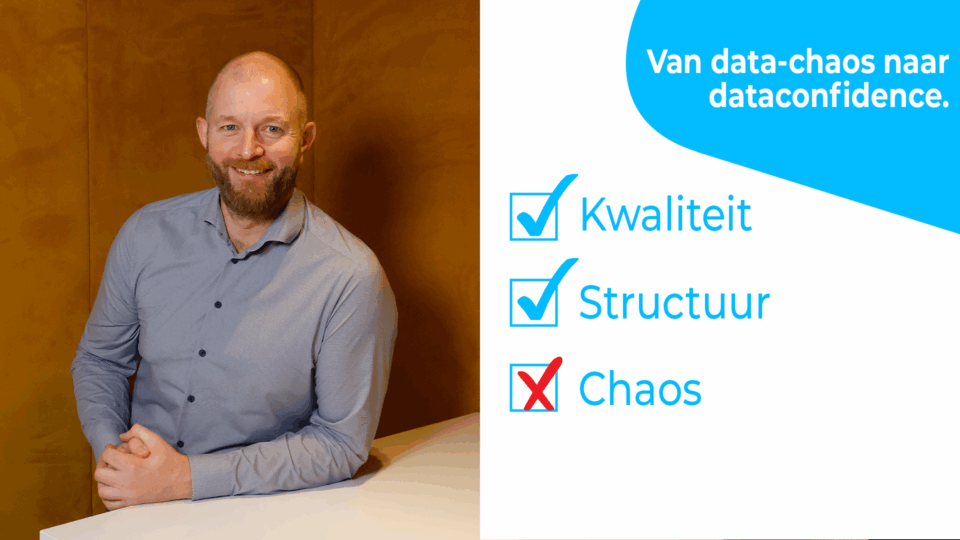
Want to know more about data quality? Follow or connect with Ruud on LinkedIn for updates on Data. Check out our other blogs on MAD-Quality.
